Combining insights from various sources such as the Forrester’s 2024 Research on event strategy, Forbes articles, and InviteDesk’s in-house event experts, this whitepaper provides a comprehensive view of the evolving event landscape in 2025. Our experts bring years of event management experience through daily interactions with clients in various industries, witnessing first-hand how event management has adapted to emerging technologies.
From trends, over challenges to tools and solutions
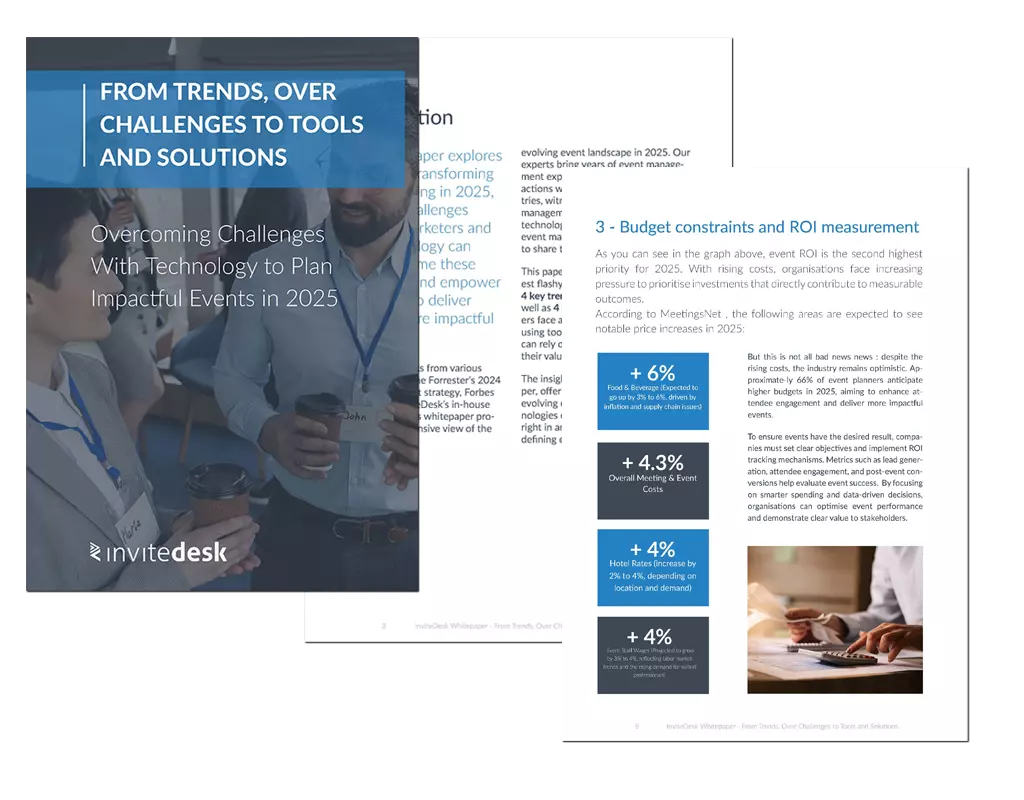
This whitepaper explores key trends transforming event planning in 2025, the main challenges faced by marketers and how technology can help overcome these challenges and empower organisers to deliver smarter, more impactful events.
Read the full article, download for free.
What is in it for you:
This paper isn’t about chasing the latest flashy. Instead, we’re focusing on 4 key trends in event management, as well as 4 key challenges event managers
face and how to overcome them using tools and technologies that you can rely on and already have proven
their value. The insights provided in this whitepaper, offer a comprehensive view of the evolving event landscape and the technologies driving it forward. Let’s dive right in and explore the four key trends defining event planning in 2025.
4 Key trends in event planning in 2025
Several key trends are emerging in 2025 that are set to transform the event planning landscape. These trends reflect the evolving preferences of both organisers and attendees, driven by changing attendee expectations and advancements in technology. In this section we will explore 4 major trends: the shift towards more in-person and smaller events, the integration of AI in event management, the focus on enhancing attendee engagement and the increasing use of automation in event planning. Understanding and leveraging these trends, can help you create more impactful and successful events.
1 – More in-Person and small events
According to a Forrester’s research, marketers are increasingly opting for in-person and smaller events. As interest in large-scale hosted events has declined by 12% year over year, these smaller gatherings, typically under 200 attendees, are now the most popular format in event marketing
strategies. This trends comes as no surprise as 80,4% 1 of event organisers agree that in-person events, are their organisations most impactful marketing
channel. In addition, event attendees and consumers also agree: 77% 2 of consumers say that interacting with a brand at a live event increases their
trust in that brand, highlighting the powerful role, in-person events and face-to-face interactions play in building brand trust as well as creating
memorable experiences. Lastly, the Freeman Trends Report for Q4 2024 states that 80% of people prefer in-person events over virtual formats.
2 – AI in event management
AI is one of the hottest and most discussed technologies lately, so of course it had to make this list. AI can instantly add a lot of value by automating tasks like content generation and event data analysis, writing compelling copy or translating texts. In addition, they can also be a fantastic source of inspiration for finding the right event location and more.
However, AI is not yet widely adopted to replace the more complex, and crucial responsibilities of an event manager such as; pre-event planning, real time attendee support, and personalised attendee experiences. These areas remain essential to successful event execution and marketers have no plans to adopt AI for these tasks in the near future. AI might lack the nuanced understanding and emotional intelligence needed to craft unique, engaging event themes that work on all senses or take creative decisions that truly resonate with attendees still rely heavily on human intuition and insight. However we believe that despite this, AI will play a role in these domain in the future to create added value and support for event managers and attendees alike.
3 – Enhancing attendee engagement
Keeping attendees engaged is critical to event success. 69% 4 of attendees prefer events that offer a meaningful, transformative experience, underscoring the importance of designing events that go beyond surface- level interaction to deliver real emotional or personal impact. Nowadays audiences have increasingly higher expectations when attending an event. They expect interactivity, as well as a convenient but personalised experience. If these expectations aren’t met, engagement decreases, and impacts heavily event ROI. According to Forbes5, weak or poor engagement leads to event professionals spending more time and money on generating leads and preventing attendee disengagement and drop-offs.
‘To meet these expectations, companies are utilizing digital platforms to enhance
the attendees’ journey before, during and after the events, creating an
interactive experience for them extending far beyond the venue.’
Source: Forbes
Download now and start increasing your event ROI from today on
In this whitepaper you will read further:
- Why small, in-person events have the biggest impact
- What 4 challenges event planners need to overcome
- How event-tech helps to invite attendees in a more targeted way, and increase your event ROI
With clear examples, concrete tips and best practices from real-world events.
Read the full article, download for free.