Bizzabo is powerful, but it’s built for conference-scale events. If you’re running hospitality events, client dinners, executive briefings, or VIP seminars and finding Bizzabo too expensive, too complex, or just overkill, this guide breaks down 8 alternatives that might fit better.
Our shortlist
Based on G2 reviews, Reddit discussions, and conversations with event teams who have switched, here are the 8 most common Bizzabo alternatives, each serving a different niche:
- InviteDesk: Sales-marketing collaboration for B2B relationship events
- Dreamcast– Perfect fit for complex environments in large-scale events
- Cvent: Enterprise-scale conferences with complex requirements
- Whova: Association conferences prioritizing attendee networking
- Splash: Brand-forward marketing teams prioritizing design
- Eventbrite: Simple, budget-conscious registration with payment processing
- Hopin: Hybrid and virtual-first events with built-in streaming
- Swoogo: Flexible workflows at mid-market prices
- vFairs: Virtual trade shows and expo-style events
Looking for a Bizzabo Alternative?
You’re probably here because Bizzabo feels like more platform than you need.
The pricing alone tells the story: $15,000-18,000/year minimum for software designed to handle 10,000-person conferences. When you’re running 30-person client dinners, the math doesn’t work.
As one Capterra reviewer put it: “I wish you’d paid less for less because there’s no refunds for an event that didn’t turn out as big as you estimated.”
But it’s not just cost. Reviews point to a steep learning curve, lengthy setup processes, and the reality that Bizzabo assumes you’re running multi-day conferences with session tracks and expo halls—not quarterly hospitality events where you just need the right 50 people in the room.
If that sounds familiar, here are 9 alternatives worth considering.
Why Listen to Us?
We built InviteDesk, an event management platform used by B2B teams at ABN AMRO, Tectum Group, and Bravida to turn relationship events into pipeline opportunities. Our work gives us a front-row seat to what actually matters when you’re running client seminars, product launches, and executive dinners.
Here’s what one customer said:
“Before InviteDesk, we didn’t have a fluid workflow. It was a madhouse… My workload has become much easier. My work has changed for the better.”
Anna-Karin Tullock, Event Manager, Bravida
So when we compare Bizzabo alternatives, we’re sharing insight from teams who’ve actually made the switch.
Book a demo to see InviteDesk in action.
What Bizzabo Does Well (And Where It Falls Short)
Bizzabo is an event management platform built for branded conferences and summits. It handles registration, attendee apps, session scheduling, exhibitor management, and analytics – the full conference lifecycle.
At its core, Bizzabo gives you:
- Registration & ticketing with complex conditional logic
- Branded attendee apps for multi-day programs
- Session management with track builders
- Exhibitor & sponsor tools for booth management
- Analytics dashboards tied to marketing automation
It’s designed for marketing teams running 500+ person conferences where brand experience and attendee engagement are primary goals.
5 Signs Bizzabo Isn’t the Right Fit
Even though Bizzabo handles conferences well, that same depth creates friction for teams running smaller relationship-focused events. Here’s why companies explore alternatives:
1. Pricing Doesn’t Match Event Scale
Bizzabo’s $15,000-18,000/year minimum makes sense for annual conferences. It’s harder to justify for monthly client dinners.
One reviewer noted: “An expensive tool for just a website.” When you’re running 20-person executive briefings, paying €53 per attendee for conference-grade software feels off.
2. Setup Takes Longer Than the Event Itself
Multiple users mention Bizzabo’s “very lengthy process to set up an event” and having to “update changes in multiple places.”
For recurring events like monthly seminars, quarterly roadshows, that setup time compounds. You spend more time configuring the platform than running the actual event.
3. Customisation Requires Technical Skills
Beyond templates, Bizzabo requires CSS and HTML expertise. One reviewer noted, Having to use support to solve everything.
If your team doesn’t have a web developer on speed dial, simple changes become support tickets that take 24-48 hours to resolve.
4. It’s Built for Conferences, Not Relationship Events
Bizzabo shines with multi-track sessions, exhibitor halls, and attendee networking. But for a 40-person client dinner where sales and marketing need to coordinate the guest list? Those features become overhead.
5. Sales Teams Stay in the Dark
Marketing controls the platform. Sales sees data when it syncs to CRM—hours or days later.
That works for conferences where attendance is the goal. It breaks down when you need specific accounts in the room and reps calling prospects who already declined.
The 9 Best Bizzabo Alternatives (And When to Use Each)
Here are the top alternatives. Each solves a different piece of the event management puzzle.
| Tool | Best For | Core Strength | G2 Rating | Pricing |
|---|---|---|---|---|
| InviteDesk | B2B relationship events with sales involvement | Sales–marketing collaboration | ⭐ 4.8 | From €211/mo |
| Dreamcast | Hybrid events, conferences, expos, and enterprise events. | QR code check-in, badge printing, hybrid event management, RFID tracking, networking, and analytics. | ⭐4.8/5 | Pricing varies based on event requirements. |
| Cvent | Enterprise conferences (1,000+ attendees) | End-to-end event suite | ⭐ 4.3 | From $15K/year |
| Whova | Association conferences | Award-winning networking app | ⭐ 4.7 | From $1K/event |
| Splash | Brand-forward marketing events | Design-first templates | ⭐ 4.6 | From $10K/year |
| Eventbrite | Simple public ticketed events | Payment processing | ⭐ 4.5 | Free – 3.7%/ticket |
| Hopin | Virtual/hybrid events | Built-in streaming | ⭐ 4.5 | From $99/mo |
| Swoogo | Mid-market marketing teams | Flexible registration workflows | ⭐ 4.6 | From $7.5K/year |
| vFairs | Virtual trade shows/expose | Virtual booth functionality | ⭐ 4.7 | From $8K/event |
1. InviteDesk
Best for: B2B teams running relationship-driven events where sales involvement and pipeline impact matter more than counting attendance.

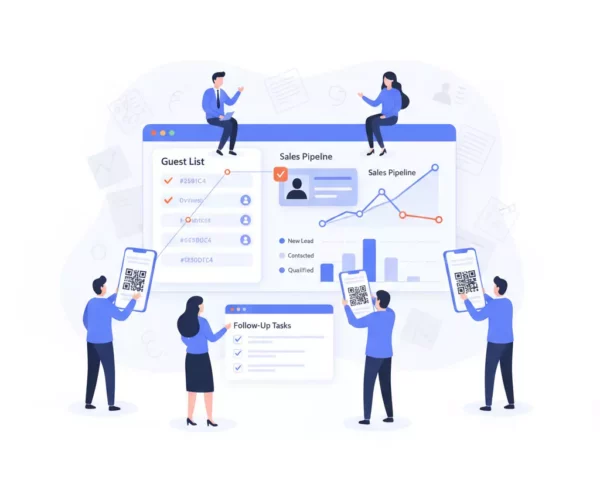
InviteDesk gives sales and marketing a shared view of every event’s guest list. Both teams see who’s invited, who confirmed, and who checked in—in real time, not after a CRM sync days later.
“Synergy between marketers and representatives is very satisfying and saves us a lot of emails and phone calls.”
Steven Peetermans, Sales & Marketing Director, Tectum Group
This visibility lets you answer:
- Which target accounts confirmed
- Whether your team should follow up now or wait
- Who showed up that sales should prioritise
InviteDesk also syncs attendance to your CRM automatically, so sales can follow up while the conversation is still warm.
Key Features
- Sales-marketing collaboration mobile app
- Real-time CRM sync (HubSpot, Salesforce, Marketo, Microsoft Dynamics)
- One-click event cloning for recurring events
- Multi-language automated invitation sequences
- QR code check-in from any smartphone
- Event registrations with customisable forms
- Post-event surveys with NPS collection
Where InviteDesk Takes a Different Approach
InviteDesk is built specifically for B2B relationship events, not conferences.
Two things stand out:
- Sales visibility that actually works. Sales reps see their guest list, confirmations, and check-ins from their phone. No waiting for CRM syncs or asking marketing for updates.
- Right-sized for your event program. Pricing starts at €211/month for teams running recurring events. Pay for what you actually use, not enterprise minimums.
This makes InviteDesk a better fit for teams running client hospitality, executive briefings, and VIP seminars, not 1,000-person conferences.
Pros
- Sales-marketing collaboration no competitor matches
- 10-minute average support response time
- EU data residency + ISO 27001 included
- Clone events in one click for recurring programs
Cons
- Not built for 1,000+ person conferences
- No native virtual event streaming (integrates with Zoom/Teams)
- Requires sales team involvement
Pricing
| Plan | Pricing (10 events/year) | Key Features |
|---|---|---|
| Plus | From €211/month | Mobile app, automated sequences |
| Premium | From €265/month | Everything in Plus + CRM integrations |
| Platinum | From €392/month | Everything in Premium + dedicated success manager |
Bizzabo starts at $17,999/year with CRM integrations priced as add-ons.
InviteDesk vs Bizzabo: Head-to-Head
| Feature | InviteDesk | Bizzabo |
|---|---|---|
| Best for | B2B relationship events | Branded conferences |
| Sales visibility | Real-time via mobile app | After CRM sync |
| CRM integrations | Included in premium subscription | Add-on |
| Pricing | From €211/month | From $17,999/year |
See how InviteDesk handles your event program.
2. Dreamcast
Dreamcast is best for: Large B2B events, on-site event management experience, trade shows, conferences, hybrid events, in-person events, virtual events, exhibitions, corporate events, and government events
Why Dreamcast Is a Great Bizzabo Alternative
Conferences, events, hybrid events, exhibitions, trade shows, and experience-driven B2B events that require reliable onsite execution and audience engagement are hosted by organisations.
Dreamcast is a technology platform for events that provides seamless integration of event registration, event engagement, hybrid event management, onsite services, and networking facilities all in one platform for a huge number of attendees. For more information, check out:
What makes Dreamcast suitable is its capability to provide both the facility of pre-event registration management, along with the capabilities of an onsite event management platform. While many platforms would only be limited to providing pre-event registration facilities, Dreamcast goes beyond that to offer functionalities like badge printing, QR code check-in, RFID integration, lead retrieval, networking, and hybrid event management.
Key Features:
- Custom registration forms and tickets
- QR check-in and registration at the venue
- Badges printing and access management
- Compatibility with RFID and cashless payments
- Support for hybrid/virtual events
- AI-enabled networking and engagement
- Exhibitor and sponsor lead retrieval tool
- Event analytics and real-time reporting dashboard
- Integration with mobile event apps
- CRM/Marketing automation integration
Pros:
- Excellent ability to manage events at venues
- Best for large and hybrid events
- More features apart from the registration process
- Tools for networking and engagement among attendees
- Can be used for conferences, expos, exhibitions, and much more
Cons:
- Some advanced features might require training and support
Pricing:
Pricing can differ depending on the event’s needs and complexity levels.
2. Cvent
Best for: Enterprise-scale conferences with multi-track agendas, exhibitor halls, and dedicated event operations staff.
 Image source: G2
Cvent is where you end up when your annual conference outgrows everything else.
Why Cvent Is a Great Bizzabo Alternative
If Bizzabo’s session management felt too limited for your 5,000-person multi-day conference, Cvent gives you more room.
You can build complex registration paths where attendees select tracks, workshops, and meal preferences. Exhibitors get their own portal. Hotel room blocks integrate directly. Smart badges and lead retrieval work at scale.
The trade-off: you’ll need someone who lives in the platform. Most organizations assign a dedicated admin or hire a Cvent-certified contractor. Training takes weeks. Pricing starts around $15,000/year and climbs past $100,000 for enterprise contracts.
For relationship events where the goal is pipeline, not attendee networking, that’s paying for exhibitor portals and session tracks you’ll never use.
Key Features
- Complex registration with track and session selection
- Exhibitor portals for sponsor self-service
- Hotel room block management
- Smart badge check-in and lead retrieval
- Deep Salesforce integration
Pros
- Handles 10,000+ attendee conferences
- Most comprehensive exhibitor management
- Deepest Salesforce integration in the category
Cons
- $15K-100K+/year pricing
- Requires dedicated admin or certified contractor
- More platform than needed for anything under 500 attendees
Pricing
| Tier | Annual Cost |
|---|---|
| Small business | From $15,000/year |
| Enterprise | $50,000–100,000+/year |
3. Whova
Best for: Association conferences where attendee networking is a primary value driver.

Whova built its reputation on attendee experience. If your event’s success depends on people connecting with each other, Whova does that part better than most.
Why Whova Is a Great Bizzabo Alternative
Attendees can browse participant profiles, schedule 1:1 meetings, join topic-based discussion boards, and exchange virtual business cards.
Setup is simpler than Bizzabo. The interface is more intuitive, and pricing is more accessible for associations and nonprofits.
The limitation: Whova is built for open-registration conferences, not curated B2B events. The platform assumes attendees register themselves. There’s no mobile app for sales teams to track their accounts. If you’re running invitation-only executive dinners, you’ll work around the platform instead of with it.
Key Features
- 1:1 meeting scheduling and profile matching
- Topic-based discussion boards
- Virtual business card exchange
- Session management with personal agenda builder
Pros
- Best-in-class attendee networking
- Simpler setup than enterprise platforms
- More affordable for associations and nonprofits
Cons
- Open-registration focus doesn’t fit invitation-only B2B events
- Limited sales team visibility
- Networking features add complexity for small relationship events
Pricing
| Tier | Cost |
|---|---|
| Basic | From $1,000/event |
| Professional | From $3,000/event |
Association and nonprofit discounts available.
4. Splash
Best for: Marketing teams running brand-forward experiential events where visual design matters most.
 Image source: G2
Splash emerged from the experiential marketing world. If your events are extensions of your brand campaigns (product launches, press events, influencer activations) Splash’s design capabilities go beyond what Bizzabo offers.
Why Splash Is a Great Bizzabo Alternative
The visual editor is genuinely best-in-class. Event pages look like they were designed by an agency. Templates are modern, customisation is intuitive, and results feel on-brand without requiring a designer.
The limitation: Splash is built for marketers, not sales-marketing alignment. The collaboration features that B2B teams need—sales rep guest management, account-level visibility—aren’t part of the platform. If you’re running quarterly client dinners rather than annual brand moments, Splash’s design capabilities become overhead you’re paying for but not using.
Key Features
- Agency-quality visual editor and templates
- Marketing automation integration
- Brand consistency tools across event series
- Event analytics and attribution
Pros
- Best-in-class visual design
- Strong marketing automation integration
- Modern, intuitive interface
Cons
- Limited sales team collaboration
- CRM integration is one-directional
- Design focus adds cost for function-over-form teams
Pricing
| Tier | Cost |
|---|---|
| Starter | From $10,000/year |
| Enterprise | Custom pricing |
5. Eventbrite
Best for: Simple, budget-conscious events where payment processing matters more than CRM integration.
 Image source: G2
Eventbrite is the default choice for a reason: it’s free for free events, simple to set up, and handles payment processing without friction.
Why Eventbrite Is a Great Bizzabo Alternative
You can have registration live in 15 minutes. No training required. The interface is consumer-grade intuitive.
For free events, it costs nothing. For paid events: 3.7% + $1.79 per ticket. No annual contracts. No minimum commitments.
The limitation: Eventbrite was built for public ticketed events. Attendee data stays in Eventbrite, so you’ll export CSVs and manually upload to your CRM. Your sales team can’t see which accounts registered. There’s no concept of personalised invitations from sales reps. For VIP B2B events, Eventbrite’s consumer branding can feel less premium than you want.
Key Features
- Free registration for free events
- Built-in payment processing
- Marketplace discovery for public events
- Mobile check-in app
Pros
- Free for free events, transparent pricing for paid
- Setup takes minutes
- Built-in payment processing and marketplace
Cons
- No CRM integration beyond CSV exports
- No sales team visibility
- Consumer branding throughout
Pricing
| Event Type | Cost |
|---|---|
| Free events | Free |
| Paid events | 3.7% + $1.79 per ticket |
6. Hopin (Now RingCentral)
Best for: Virtual-first and hybrid events where built-in video streaming eliminates the need for separate webinar tools. 
Hopin emerged during the pandemic as a virtual event platform. If your event strategy is primarily virtual, Hopin’s native streaming sets it apart.
Why Hopin Is a Great Bizzabo Alternative
Streaming is built in. Attendees don’t need separate software. Breakout rooms, networking lounges, expo areas, and live polls are all part of the platform.
Hopin handles simultaneous in-person and virtual tracks better than platforms that added virtual features as an afterthought.
The limitation: if your events are primarily in-person relationship gatherings, Hopin’s virtual DNA becomes overhead. A 30-person dinner doesn’t need breakout rooms or virtual expo halls. And you’re paying for streaming infrastructure whether you use it or not.
Key Features
- Native video streaming
- Breakout rooms and networking lounges
- Virtual expo areas with booth capabilities
- Live polls and Q&A
- Hybrid event management
Pros
- Native streaming eliminates Zoom/Teams complexity
- Strong virtual engagement features
- Good hybrid event support
Cons
- Less optimised for in-person-only events
- Virtual features add cost for relationship dinners
- CRM integration not as deep as B2B-focused tools
Pricing
| Tier | Cost |
|---|---|
| Starter | From $99/month |
| Business | From $500/month |
7. Swoogo
Best for: Mid-market marketing teams seeking flexible registration workflows without enterprise complexity.

Swoogo positions itself between consumer tools like Eventbrite and enterprise platforms like Cvent.
Why Swoogo Is a Great Bizzabo Alternative
Registration workflows are flexible. Complex logic—conditional questions, multiple ticket types, approval workflows—doesn’t require a dedicated admin.
The interface is cleaner and more intuitive than legacy enterprise platforms. Mid-market pricing makes it more accessible than Cvent or Bizzabo.
The limitation: Swoogo is built for marketing-led events, not sales-marketing collaboration. Sales reps can’t check guest lists from a mobile app. The integration ecosystem is smaller than larger platforms.
Key Features
- Flexible registration with conditional logic
- Multiple ticket types and pricing tiers
- Marketing automation and CRM integrations
- Event website builder
Pros
- Flexible registration without enterprise complexity
- Modern self-serve interface
- Mid-market pricing with solid functionality
Cons
- No sales team mobile app
- Smaller integration ecosystem
- Less specialised than purpose-built tools
Pricing
| Tier | Cost |
|---|---|
| Starter | From $7,500/year |
| Professional | From $15,000/year |
8. vFairs
Best for: Virtual trade shows and expos where booth-based experiences and exhibitor management are primary requirements.

vFairs carved out a niche in virtual exhibitions. If you need the digital equivalent of walking a trade show floor, vFairs does that better than general-purpose platforms.
Why vFairs Is a Great Bizzabo Alternative
The virtual booth experience is the core product. Attendees navigate a visual environment, visit exhibitor booths, download resources, and chat with booth staff.
Exhibitor management tools are strong. Multiple exhibitors can customise their booths and retrieve leads without going through your team.
The limitation: vFairs is purpose-built for expo-style events. An executive dinner doesn’t need virtual booth navigation. Per-event pricing works for occasional large expos but adds up for recurring events.
Key Features
- Virtual booth environment with exhibitor customisation
- Exhibitor lead retrieval and analytics
- Career fair capabilities
- Resource downloads and booth chat
- Webinar and session hosting
Pros
- Best-in-class virtual booth and expo experience
- Strong exhibitor management
- Good fit for career fairs and recruiting events
Cons
- Expo format doesn’t translate to relationship events
- Per-event pricing expensive for recurring programs
- Virtual-first platform with less mature in-person tools
Pricing
| Tier | Cost |
|---|---|
| Standard | From $8,000/event |
| Premium | From $15,000/event |
When You Should Stick With Bizzabo
Before switching, consider whether Bizzabo actually fits your needs:
- You run large conferences (1,000+ attendees) with multi-track agendas and exhibitor management
- You prioritise smart badge/wearable tech (Klik integration)
- You need native Salesforce/HubSpot integration at enterprise depth
- You have budget for premium support and implementation ($15K+/year)
- Branded attendee experiences are your top priority and complexity is acceptable
If these describe you, Bizzabo may still be right. This guide is for teams whose needs don’t match Bizzabo’s strengths—particularly B2B relationship events where €53/attendee doesn’t make sense.
Your 6-Step Framework for Choosing the Right Platform
Here’s how I recommend thinking about it:
- Diagnose your pain: What’s your #1 frustration with Bizzabo? Pricing? Sales collaboration? Complexity? Start there.
- Match to event type: Large conferences, intimate B2B dinners, or recurring relationship events—tools specialise differently.
- Calculate true cost: Do the math for your event volume. Per-event pricing vs. subscription models tell different stories at scale.
- Test the experience: Create a mock event. Go through registration as both organiser and guest. You’ll spot friction early.
- Check compliance: Where is data stored? GDPR/ISO certifications? Will Legal approve?
- Think long-term: As your event program grows, can this platform scale with you?
Quick Decision Guide: Which Alternative Fits Your Events?
The best Bizzabo alternative depends on your event program’s specific needs:
- For enterprise conferences with 1,000+ attendees → Cvent
- For association events prioritising networking → Whova
- For brand-forward marketing events → Splash
- For simple public ticketed events → Eventbrite
- For virtual/hybrid as primary format → Hopin
- For mid-market flexibility → Swoogo
- For virtual trade shows → vFairs
But if you’re running B2B relationship events where proving pipeline impact and managing curated guest lists matters more than conference-scale features, InviteDesk’s purpose-built approach solves problems Bizzabo wasn’t designed to handle.
See how InviteDesk handles your specific event program in a live demo.
FAQs
Is there anything better than Bizzabo for small B2B events?
For small B2B relationship events (30-200 attendees), InviteDesk is purpose-built for your use case. You get sales-marketing collaboration, real-time CRM sync, and right-sized pricing without paying for conference-scale features you don’t need.
Can I switch from Bizzabo mid-contract?
Most Bizzabo contracts are annual with auto-renewal clauses. Switching mid-contract usually means paying for both platforms. The cleanest window is after your contract ends and at least six weeks before your next major event—giving you time to migrate data and run a test event.
What’s the difference between Bizzabo and InviteDesk?
Bizzabo is built for branded conferences with 500+ attendees, multi-track sessions, and exhibitor halls. InviteDesk is built for B2B relationship events where sales and marketing need to coordinate on getting the right accounts in the room. Key difference: InviteDesk’s mobile app lets sales see their guest list, confirmations, and check-ins in real time.
Does Bizzabo integrate with Salesforce/HubSpot?
Yes, but CRM integrations are add-ons with separate pricing. InviteDesk includes HubSpot, Salesforce, Attio, and Copper integrations in all plans with real-time sync.


![Cvent vs Eventbrite: We Reveal The Best Option for B2B Events [With Infographs]](https://invitedesk.com/app/uploads/2026/03/Cvent-vs-Eventbrite-600x480.webp)