Here’s the uncomfortable truth: the global events industry is headed toward $2.1 trillion by 2032, yet 71.2% of event organizers still find it difficult to prove ROI to their stakeholders.
If you’ve ever finished an event feeling like it went well but struggled to back that up with actual data, this guide is for you.
We’re going to walk through which metrics actually matter, when to track them, and how to use that data to run better events.
And because theory only gets you so far, we’ve built a calculator you can actually use to measure your event’s success, and turn insights into action.
Your Free Event Measurement Toolkit
Before we dive into the metrics that matter, let’s get practical. You can read about measurement all day, but what you actually need is a system to track your events consistently.
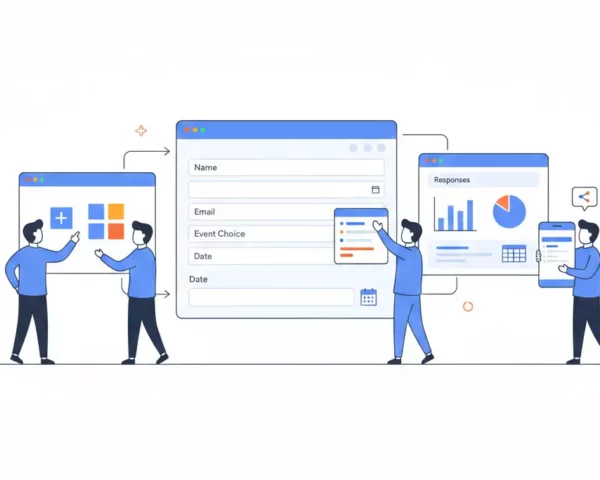
That’s why we’ve built a free Event Measurement Tracker spreadsheet that does the math for you. It includes:
- Dashboard – At-a-glance view of your last 10 events with color-coded performance status
- Event Tracker – Simple data entry for registrations, attendance, costs, revenue, and engagement
- Metric Calculator – Automatic calculations for conversion rates, NPS, ROI, cost per attendee, and cost per lead
- Pre-Event Planning – Worksheet to define goals and set benchmarks before your event starts
- Benchmark Comparison – Compare your performance against industry standards automatically

No complicated formulas. No manual calculations. Just enter your event data once, and the tracker calculates everything from conversion rates to ROI instantly.
Download the FREE Event Measurement Tracker
Now, with your tracking system ready to go, let’s talk about what might be going wrong with your current measurement approach, and how to fix it.
Why Your Event Measurement Probably Isn’t Working
Let’s start with what’s broken, because chances are you’re running into at least one of these pitfalls right now:
Pitfall #1: Measuring everything and nothing
When you track 30 metrics because they all seem important, you end up drowning in spreadsheets without clear answers. Senior event leaders track 8-12 carefully chosen KPIs. That’s it. More telling: 54% don’t track registrations, 53% don’t track opportunities created, and 40% don’t track attendance rates at all.
Pitfall #2: Using the wrong benchmarks
Here’s something most people get wrong: 67% of in-person event organizers use attendance as their primary success metric, but only 45% of virtual event marketers do the same, revealing a fundamental disconnect in how different event formats measure value. If you’re comparing your virtual webinar to in-person conference benchmarks (or vice versa), you’re setting yourself up for confusion.
Pitfall #3: Measuring too late
Timing determines whether anyone fills out your post-event survey. The reason is simple: attendees need to remember specific details while the event is still fresh in their minds. Send your survey within 24-48 hours and you’ll capture 20-30% response rates because sessions, conversations, and pain points are still vivid.
Wait 72 hours and memory fades, response rates drop by half as attendees move back to their normal routines. By the time you hit a week, you’re in single digits because your event has been mentally filed away and replaced by more pressing concerns. The takeaway: treat post-event surveys like breaking news, not quarterly reports.
Pitfall #4: Only tracking registrations, not what matters
Registration numbers tell you who signed up. Attendence rates tell you who actually valued your event enough to show up. One is a vanity metric, the other predicts business outcomes.
Start With Your Goal, Then Pick Your Metrics
Before you measure anything, get clear on what success actually means. Not every event has the same objective, and that’s fine. What’s not fine is measuring the wrong things because you didn’t define success up front.
Here’s how different goals map to different metrics:
Brand Awareness Events You’re measuring reach and visibility: total registrations, social media mentions (not just impressions), earned media impressions, and share of voice. Consider this: 78% of organizers identify in-person events as their organization’s most impactful marketing channel, so if brand building is your goal, the data supports going all-in.
Lead Generation Events You’re tracking pipeline creation and quality: lead conversion rates, sales qualified leads, cost per lead, and pipeline influenced. Important context: webinars average $72 per lead, trade shows cost $198 per lead, and conferences run $811 per lead. Know what you’re paying.
Revenue-Focused Events You’re measuring financial performance: gross revenue, cost-to-revenue ratio, ROI, revenue by source. The benchmark here: 52% of business leaders say event marketing is their primary driver of ROI, so if you can prove this, you’re validating what leadership already suspects.
Thought Leadership Events show your organization as a go-to expert in your industry. Here, you track media coverage and journalist attendance. Look at requests for speaking opportunities after the event, as well as downloads and engagement with thought leadership content. Also monitor LinkedIn connections and follower growth from attendees, plus participation from influencers and industry experts.
Customer Hospitality Events focus on strengthening relationships, not generating new leads. Measure account health scores before and after the event, as well as retention rates for attendees versus non-attendees. Look for upsell and cross-sell opportunities, the depth of executive relationships, and customer satisfaction and renewal likelihood. For example, a dinner with 20 key accounts protecting $2M in renewals can have more impact than a webinar with 200 leads.
Community-Building Events You’re tracking engagement and loyalty: Net Promoter Score, returning attendee rates, session engagement, and connection quality. These events prioritize depth over breadth—a smaller crowd that’s deeply engaged beats a packed room of passive attendees.
Education-Focused Events You’re measuring learning outcomes: session ratings, knowledge retention, certification completion, skill application. The goal isn’t just attendance—it’s demonstrable learning.
Once you know your primary goal, build a balanced scorecard with 2-3 metrics from five categories: engagement, brand reach, financial performance, sponsorship value, and sales pipeline. And here’s the move that separates good event managers from great ones: set three benchmarks before your event starts—minimum viable (can’t go below), target (industry average), and stretch (top 25% performance).
The Metrics You Should Keep Track Off
No-Show Rate (or Registration-to-Attendance Rate)
This is the percentage of registered attendees who don’t show up—your reality check on whether people actually value your event.
Calculate it: (No-Shows ÷ Total Registrations) × 100 or flip it: (Actual Attendees ÷ Total Registrations) × 100
| Event Type | Typical No-Show Rate | Good Performance |
|---|---|---|
| In-person events | 25–40% | <25% |
| Virtual events/webinars | 43–60% (avg 43%) | <28% |
| Hybrid events (in-person) | 40–50% | <35% |
| Hybrid events (virtual) | 55–65% | <50% |
If your no-show rate is above 60%, something’s fundamentally wrong—inviting the wrong people, bad timing, weak value proposition, or ineffective pre-event communication. And here’s a conversion killer most people miss: every additional step in your registration process causes a 10% drop in conversions. Each extra form field is costing you attendees.
Data point to consider: 90-minute webinars achieve the highest attendance at 72%. People who commit to longer sessions tend to be more serious about showing up.
Net Promoter Score (NPS)
Ask one question: “On a scale of 0-10, how likely are you to recommend this event?” Subtract detractors (0-6) from promoters (9-10).
Benchmarks that matter:
- B2B events: 10-30 is typical, 30-50 is excellent, 50+ is world-class
- Consumer events: 20-40 is average
- Industry average across all sectors: 32
- Top 25% threshold: 72+
Why this matters more than you think: NPS predicts whether people will return and whether they’ll tell their colleagues. It’s a leading indicator of long-term success. An event with 500 attendees and an NPS of 45 will outperform an event with 800 attendees and an NPS of 15 every single time.
Session Engagement Rate (mainly if you’re running virtual events)
Attendance doesn’t tell you if your content connected. Track active participation through Q&A, polls, chat, and downloads.
Here’s how you can calculate session engagement rate:
Count unique attendees who took ANY action during your session: submitted a question, answered a poll, sent a chat message, downloaded a resource, or clicked a link.
Use this formula: (Active Participants ÷ Total Attendees) × 100
Let us give you a quick example: You have 200 people in your webinar. During the session, 50 people asked questions, 80 answered polls (some overlap with the question-askers), 30 downloaded your slide deck. Total unique active participants = 95 people. Engagement rate = (95 ÷ 200) × 100 = 47.5%
Most webinar platforms (Zoom, Hopin, ON24) calculate this automatically in their analytics dashboard. For in-person events, track poll responses via event apps, questions asked during Q&A, and resource downloads from QR codes.
The benchmarks:
- Live webinars: 20-30% standard, 40%+ is high performance
- In-person sessions: 15-25% standard, 35%+ is high performance
- Interactive workshops: 40-60% standard, 70%+ is high performance
Here’s the stat that makes this critical: attendees who engage with Q&A, polls, or chat are 30% more likely to convert to customers compared to passive attendees. Engagement predicts revenue outcomes, not just satisfaction.
And here’s something that should change how you plan content: 40% of viewers stay for an entire 60-minute webinar on average. If you’re way below that, figure out where you’re losing people. If they drop in the first 10 minutes, your opening isn’t compelling. If they stay 40 minutes, then bail, you’re running too long.
Also worth noting: 89% of webinar attendees take some post-event action—visiting your website, downloading content, or requesting more information. That’s huge if you’re tracking through your funnel.
Cost Per Attendee
Divide total event costs by actual attendees. Include everything: venue, catering, technology, marketing, staff time, travel, overhead. All of it.
Current cost trends:
- Small meetings (<200 people): Costs increasing 1.5% annually
- Conferences & trade shows: Costs increasing 3% annually
- Virtual events: 40-60% lower cost per attendee than in-person
- Budget reality check: 29.6% of organizers manage budgets between $1-2 million
The critical comparison: if your cost per attendee is less than 1/3 of customer lifetime value, you’re in good shape. If it’s approaching half, your event economics need restructuring.
Event ROI
The formula everyone wants to see: ((Total Revenue – Total Costs) ÷ Total Costs) × 100
| ROI Range | Performance Level | What It Means |
|---|---|---|
| 0% | Break-even | Minimum viable |
| 50–100% | Good | Standard success |
| 100–200% | Excellent | Strong performance |
| 200%+ | Outstanding | Top-tier execution |
Real-world context:
- B2B SaaS webinars average 213% ROI (this is why everyone’s doing webinars)
- One company using Eventbrite Ads reported 558% ROAS—$5.58 for every dollar spent
- Another saw impression rates boost by 14x after optimizing their promotional strategy
The catch: you need to calculate ROI the same way every time. Pick a measurement window (90 days for B2B, 30 days for direct revenue), include all costs consistently, and use the same attribution model across events. Otherwise, you’re comparing apples to rockets.
Lead Economics: Beyond Cost Per Lead
If you’re running lead generation events, these numbers matter more than attendance.
Cost per lead benchmarks by format:
| Event Format | Average Cost Per Lead |
|---|---|
| Webinars | $72 |
| Trade shows | $198 |
| Conferences | $811 |
But cost per lead is meaningless without conversion context. Here’s what actually matters:
Conversion benchmarks through the funnel:
- Average lead conversion across industries: 2-5%
- B2B SaaS companies: 5-10% lead-to-customer
- Educational webinars: 15-25% conversion
- Sales-focused webinars: 10-20% conversion
- Marketing webinars: 5-15% conversion
The math that matters: if your average customer is worth $10,000 and you convert 5% of leads, each lead is theoretically worth $500. An event costing $30,000 that generates 100 qualified leads creates $50,000 in potential customer value. That’s a strong investment before you factor in brand awareness or relationship building.
And here’s a benchmark most people don’t track: 73% of B2B webinar attendees become leads, compared to just 20-40% for B2C attendees. If you’re in B2B, webinars are one of your highest-leverage formats.
Engagement: What Happens During Your Event?
Financial metrics tell you if you made money. Engagement metrics tell you if you created value. Let’s look at some of these metrics:
Real-Time Engagement Signals
For virtual events, the retention curve tells you everything. 40% of viewers stay for a full 60-minute webinar on average. If you’re significantly below that, you have a content problem. The average webinar had 216 attendees in 2024, up 7% year-over-year, so the format is growing—but only if you can keep people watching.
For in-person events, dwell time reveals true interest:
| Location | Low Engagement | Standard | High Engagement |
|---|---|---|---|
| Trade show booth | <2 minutes | 3–7 minutes | 10+ minutes |
| Networking area | <10 minutes | 15–30 minutes | 45+ minutes |
| Breakout session | Early exits | Full duration | Lingering after |
If people are spending under 2 minutes at your booth, either your targeting is off or your messaging isn’t compelling. If they’re staying 10+ minutes, they’re genuinely interested—make sure sales follows up.
Getting People to Actually Complete Your Survey
You need 20-30% response rates to get meaningful data. Here’s what we’ve seen work:
#1 Timing is everything. Send within 24-48 hours and you hit 20-30% response rates. Wait 72 hours and that drops by 50%. Wait a week and you’re in single digits. High-engagement events can hit 24-30% if you move fast.
#2 Keep it ruthlessly short. 8-12 questions maximum—ideally closer to 10. Use rating scales for quantitative data, a few multiple choice questions, and limit open-ended questions to 2-3.
#3 Mobile-optimize everything. 97% of people complete surveys on their phones. If yours doesn’t work well on mobile, you’ve eliminated almost everyone before they start.
#4 Offer a small incentive. Access to recordings, a summary report, or a discount on your next event boosts response rates by 15-20%. The incentive doesn’t need to be expensive—it just needs to feel valuable enough to justify five minutes.
Social Media and Brand Impact (If That’s Part of Your Strategy)
Your event’s reach extends way beyond the room. Here’s what to track and what performance looks like.
Social Media Engagement
Don’t track impressions—track engagement rate. Calculate it: (Total Interactions ÷ Total Impressions) × 100
Platform benchmarks:
| Platform | Average Engagement Rate | High Performance |
|---|---|---|
| 5.0% | 7.1%+ (entertainment) | |
| 3.6% | 4.2%+ (financial services) | |
| 1.06% | 2.0%+ | |
| Twitter/X | 0.5% | 1.5%+ |
Video posts get 2.5-3x more engagement than photos across platforms. If you’re creating highlight reels or speaker clips, prioritize video. And here’s something that matters: 70% of the most-used hashtags on Instagram are branded hashtags. Create a unique event hashtag and own that conversation.
Earned Media Coverage
Track media mentions, outlet quality, coverage tone, and total potential impressions.
Performance benchmarks:
| Event Scope | Strong Performance |
|---|---|
| Local events | 100,000+ impressions |
| Regional events | 500,000+ impressions |
| National events | 1,000,000+ impressions |
But don’t just count impressions. Track whether coverage drives actual outcomes—website traffic spikes, registration increases, specific leads or opportunities you can attribute to press mentions.
Email Marketing Performance (Because You’re Probably Sending Follow-Ups)
Open rate benchmarks:
- Average email open rate: 21.5-40% depending on type
- Event invitations: 21.5-28.5%
- Welcome emails: 83.63% (the highest-performing email type)
- Post-event follow-up: 35-40%
- Automated campaigns: 38.10% open rate vs. 33.25% for one-time sends
Best practices backed by data:
- Monday has the highest open rates at 22.0%
- Tuesday has the highest click-through rates at 2.4%
- Average click rate: 2.03% (ranging 0.8-3.8% by industry)
The takeaway: automate your follow-up sequences, send on Mondays and Tuesdays, and track open rates to see if your subject lines are working.
Connecting Events to Revenue (The Part Executives Actually Care About)
For B2B events, you need to prove pipeline impact. This means tracking attribution from registration through closed deals.
Tag every lead in your CRM: when they register, when they attend, when they engage with sessions, when they visit booths. This lets you measure two critical metrics:
Pipeline Generated: Opportunities that started directly from the event Pipeline Influenced: Any opportunity where the event played a role (typically 3-5x larger than generated)
Performance benchmarks:
| Pipeline Impact | Performance Level |
|---|---|
| 20-30% of total pipeline | Strong |
| 30-40% of total pipeline | Excellent |
| 40%+ of total pipeline | Outstanding |
Also track sales cycle impact. If your average sales cycle is 90 days but event-influenced deals close in 60 days, calculate the dollar value of that acceleration. If faster velocity lets you close three extra $50k deals per quarter, your event is generating $150k in additional revenue just from acceleration—separate from new pipeline creation.
And here’s a conversion stat that matters: LinkedIn generates the highest visitor-to-lead conversion rate at 2.74%, significantly outperforming other social platforms. If you’re promoting B2B events, LinkedIn should be a primary channel.
Build Your Own Benchmark Database
Industry benchmarks give you a starting point, but your most valuable comparison is your own historical performance.
Track the same metrics across every event:
| Event | Date | Registrations | Attendees | Conversion | NPS | ROI | Cost/Attendee | Cost/Lead |
|---|---|---|---|---|---|---|---|---|
| Q1 Webinar | Jan 15 | 450 | 225 | 50% | 42 | 175% | $32 | $68 |
| Spring Conf. | Mar 22 | 320 | 245 | 77% | 38 | 145% | $285 | $195 |
| Summer Workshop | Jun 10 | 85 | 78 | 92% | 51 | 210% | $145 | — |
Over time, you’ll see patterns. Maybe Q1 events always have lower NPS because people are busy. Maybe conferences deliver better lead quality but webinars deliver better ROI. These insights only emerge from consistent tracking.
When something underperforms, treat it as data, not failure.
Low conversion? Check your messaging and timing.
Low NPS? Review survey feedback.
Low engagement? Analyze your content format. Each metric tells a story—your job is to read it and respond.
Test Small, Measure Everything
Event improvement happens through small, measured tests, not dramatic overhauls.
Try different registration flows and measure conversion impact. Test promotional messages and track registration response. Experiment with session formats and measure engagement differences. Test follow-up strategies and analyze lead conversion.
Document what you test, measure, and learn. A 10% improvement per event compounds fast—five events with 10% improvement each creates significant gains without any single heroic effort.
The Three Mistakes That Kill Measurement
1. The inconsistency problem:
Measuring ROI at 30 days for one event and 90 days for another makes comparison impossible. Standardize your formulas, cost inclusions, and measurement windows. Include all costs—venue, catering, tech, marketing, staff time, overhead. Use the same measurement window (90 days for B2B, 30 days for direct revenue). Pick one attribution model and stick with it.
2. The attribution gap:
Tracking leads generated without tracking what happens to them means you can’t prove revenue impact. The fix: integrate your registration platform with your CRM. Tag every lead from registration through closed deal. This is the only way to prove your event generates revenue, not just interest.
3. The real-time blindness:
Waiting until after the event to look at data means missing chances to fix problems while they’re happening. The biggest challenge in measuring event success is the lack of real-time feedback and flexibility to adjust on the fly. Assign someone to monitor key metrics during the event—check-in rates, session attendance, engagement levels, social sentiment. Fix problems immediately, not after they’ve already affected the experience.
Your Implementation Timeline (simplified)
8 weeks before: Establish your framework (primary goal, 8-12 KPIs, three-tier benchmarks). Create your survey. Set up tracking infrastructure (promo codes, CRM tags, analytics). Brief your team.
During the event: Monitor in real time. Track check-ins, session attendance, engagement, and social sentiment. Fix problems on the spot.
24-48 hours after: Send your survey immediately. Begin lead nurturing.
1 week after: Calculate attendance, conversion rates, engagement metrics, NPS, and preliminary financials.
30 days after: Complete financial analysis. Track lead progression through the funnel. Create stakeholder report.
90 days after: Calculate final ROI including closed deals. Track customer acquisition. Measure pipeline influenced.
The Bottom Line
You don’t need to track every possible metric. You need to track the right metrics consistently and use what you learn to improve.
Start with your primary goal. Select 8-12 metrics across engagement, reach, financial performance, sponsorship, and pipeline. Use industry benchmarks to set realistic targets. Build the infrastructure to capture data before, during, and after your event.
Most importantly: actually use the data. The goal isn’t impressive reports for stakeholders—though that helps. The goal is learning from each event and making the next one better.
The event leaders who consistently prove ROI aren’t the ones with the fanciest analytics dashboards. They’re the ones who pick metrics aligned with business goals, track them consistently, and use insights to make specific improvements. That disciplined approach transforms events from uncertain expenses into reliable growth drivers.
And here’s the reality: 57% of event organizers saw increased attendance over the past year. The industry is growing, budgets are growing (53.2% expect budget increases in 2025), and events work. Your job is to prove it with data your CFO can’t argue with.